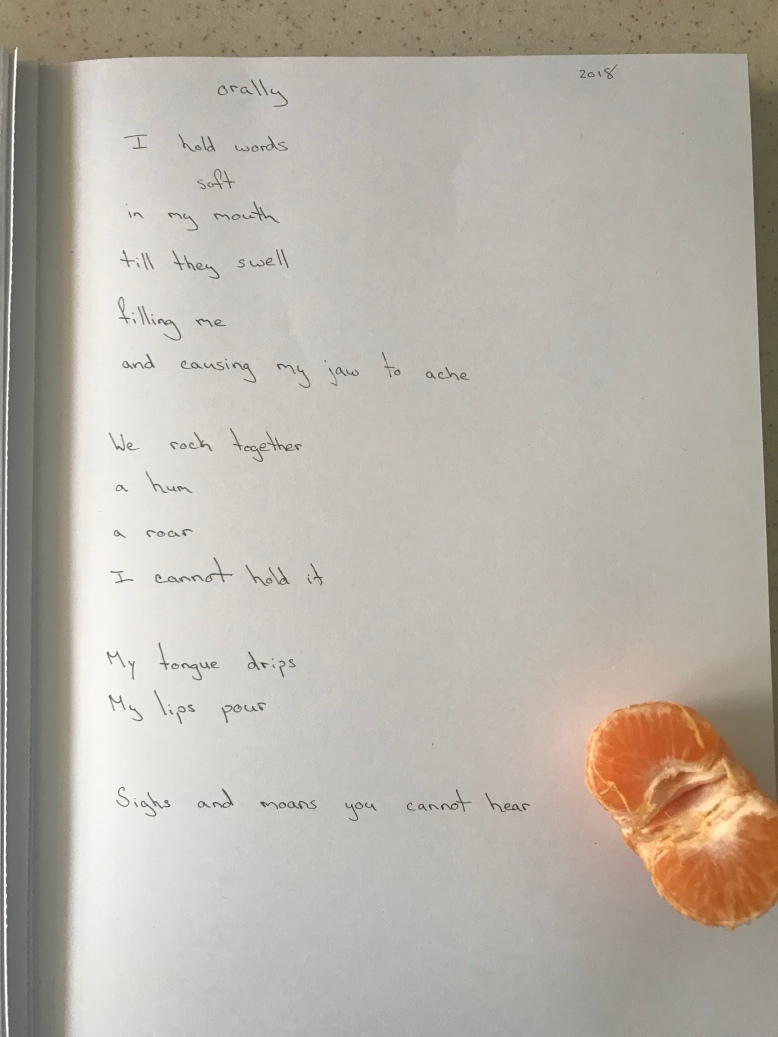
erosion
A lilac sky lies over winter-black hills and I wonder why you chose me.
You stumble and seem alarmed at having been asked a question directly.
I think I did that to you.
I see now that I am like wind, like water;
who could stand before me?
I have bent your will.
I have tried to make you into what I myself long to be.
But your nature resists and
I was wrong to try.
I will alter my banks and flow another way.
What force will shape you then?
Sleepy Dark Water
I stand on a rock ledge at night
feet firm on the cool damp stone
face raised to the wind and the mist upon it.
I step out over dark water
and without a ripple
I am gone.
Love Letter
My dearest love,
I have watched you from your birth. From the moment you emerged from your mother, I have known you and loved you.
And before then.
I waited for your father to journey across the sea. For your parents to make their catastrophic and fruitful union.
I knew you and loved you before you existed. Before time existed I claimed you as my own. You are mine.
You are a star among vast galaxies, a grain of sand, a blade of grass, yet I see your singularity. You are not a meaningless replica. You are you. You are as I made you and I make you perfect.
You think you are a song without sound, expressionless expression. But I see you, you matter to me.
I knew you and loved you before you were born and when your mortal life has passed I will still love you. When your name is forgotten on the Earth, in one generation, or three, or ten, I will remember you. I am eternal, and so you are too.
corn
I am not a farmer and
the corn has nothing to do with me
but I like to watch it come up
as if by watching I could slow it down, still the moment, and make it mine.
I like to see the liquid black manure coating the fields and then
the couple of little leaves just an inch or two above the ground.
Then faster than possible a foot tall,
then two feet,
then over my head and rustling in the wind,
then tassels.
All summer long I watch its progress.
But it has nothing to do with me.
I dreamed I missed it this year. That it had sprung up and been harvested before I’d had a chance to watch it.
see you when i see you
Last night the dogs went crazy
every time the plow went by
I was glad to hear you made it home alive
I left some supper on the stove for you
eat it or put it away, ok?
Remember to call your sister
and the oil man
Leave some supper on the stove for me
I’ll eat it or put it away.
Pizza is Worth It
Sorry for beating a dead horse – I know I’ve said before that I miss my hometown pizza. I’ve spent a few years trying to perfect homemade. It’s not the same, but it is pretty darn good. Better than what I can get in the local pizza shops anyway.
Someone – an online stranger someone – just asked me why I bother to make pizza crust when there are buy-able options in the grocery store: flatbreads, pre-made crusts, tortillas, etc. Now, you and I know that it’s because I’m a pizza snob, but the question made me a little bit crazy because
why do ANYTHING?
Why knit socks when you can buy them? Why sweep your floor instead of hiring someone? Why do your own laundry or wipe your own ass? Why do anything that requires any effort?
Because there is something either about the process or about the end product that makes it worth it to you, right? You’ve likely done an internal and informal cost/benefit analysis.
Here is my casual single serving recipe for real pizza that comes in around 250 calories:
1/4 cup flour, 1/4 tsp. yeast, 1/8 tsp. salt, 1/2 cup homemade tomato sauce, 1 ounce mozzarella.
Mix flour, yeast, salt with enough warm water to make a dough, knead briefly with fingertips, let rise.
Pre heat oven and cast iron pan (or pizza stone) to about 500 degrees (higher if you can).
Stretch dough, let rest if stiff, then stretch again. I got mine to about 6 or 8 inches across.
Spray pan with oil, lay in dough, bake for 6-ish minutes.
Remove from oven, apply sauce and cheese, put back in oven till cheese is how you like it.
Familiar Poem
My heart is a stone
hung round my neck.
I am drowned in the depths of your sea.
This sounds too familiar, so either I’ve written it before or I’ve stolen it. Anyone?
Live in the Light
The mist was rising from the fields of stubble and the sun was beginning to peek over the hills beyond and it made me think of “catches the gleam of the morning’s first beam” and that always brings a tear to my eye, patriot that I am.
So, I stopped the car, put on my hazards, and got out. I looked long at that sunrise and decided to share it.
But the photo never catches the light quite right.
So much of what we call art is an attempt to catch the light, or to shine light into dark places. And why not? We are creators created in the the image of the Creator and He said, “Let there be light.”
But we can only do so much.
Vacationers take pictures of miracle sunsets and if they’re skilled or lucky, the photos look like advertisements for spiced rum or suntan lotion. They never reflect even a fraction of the beauty that was in the moment.
The painters I love the best are the ones who try to catch the light and catch the moment. The Dutch masters, Hudson River School, and oh my Caravaggio’s chiaroscuro.
Even writers try to catch the light. C.S. Lewis describes that dark moment before the dawn in his resurrection scene in The Lion, the Witch and the Wardrobe. That moment when dawn begins to break but you’re not quite sure if it’s your imagination that things are lighter and you can’t quite pinpoint when it started to happen. That scene will break your heart.
Light is fleeting. Light changes with the angle, the second, the object which reflects. And THIS sunset, THIS candle flame, THIS particle of light, this moment will never exist again.
Live in the moment. Live in the light.
Common Ground
I should be cleaning in preparation for Mom’s visit or pre-reading Jurassic Park for Jack or planning school for next week or sorting laundry. And I will do all those things today. And I’ll cook and do dishes and exercise. I love ticking things off a list and I love an organized house.
But for the past hour I’ve just been looking out the window at the clumps of snow blowing off the trees and listening to the sounds. The jays, the furnace, wind chimes, the boys…
They are squabbling good-naturedly over legos and making exploding sound effects as they “blow up” each other’s creations. Gosh, the years have gone fast.
We’ve been in our new area for over five years now. The kids have really grown up here. They are less like transplants and more like natives. Their accents have changed. Ah well, it’s been good. They have a freedom here they never could have had back home.
Me too. I have become strong and confident here. The space has given me room to grow in ways I was afraid to. But
truth?
I still feel like a stranger here. There’s a feeling of always having to explain myself. It’s not exactly homesickness. I don’t miss the noise, the lights, the crowds, the litter, the smells, the sadness. But sometimes I miss the energy, the common ground, and yes, the pizza.
Crazy. I didn’t move to Thailand, just a different part of my own home state. But it really does feel very different.
 Breaking Ground